> ## Documentation Index
> Fetch the complete documentation index at: https://docs.brm.ai/llms.txt
> Use this file to discover all available pages before exploring further.
# The Relationship View
Every vendor relationship spans years of contracts, payments, and conversations — most of it scattered across systems, inboxes, and the institutional memory of people who may no longer be on your team. The Relationship View brings it all together, organized and ready, before you ask.
Whenever you need to make a decision on a vendor, answer a question from the team, or bring insights to the business, you have to go and piece together the facts and the context for the relationship in question. That context lives in support tickets, in emails from teammates who've since moved on, and in commitments made before a deal closed that never made it into the final document. Until now, pulling all of that together took hours — if it happened at all. The Relationship View assembles the full picture, facts and context, automagically for every vendor in your portfolio.
✅ Available now for all BRM customers
 ## **What Is the Relationship View?**
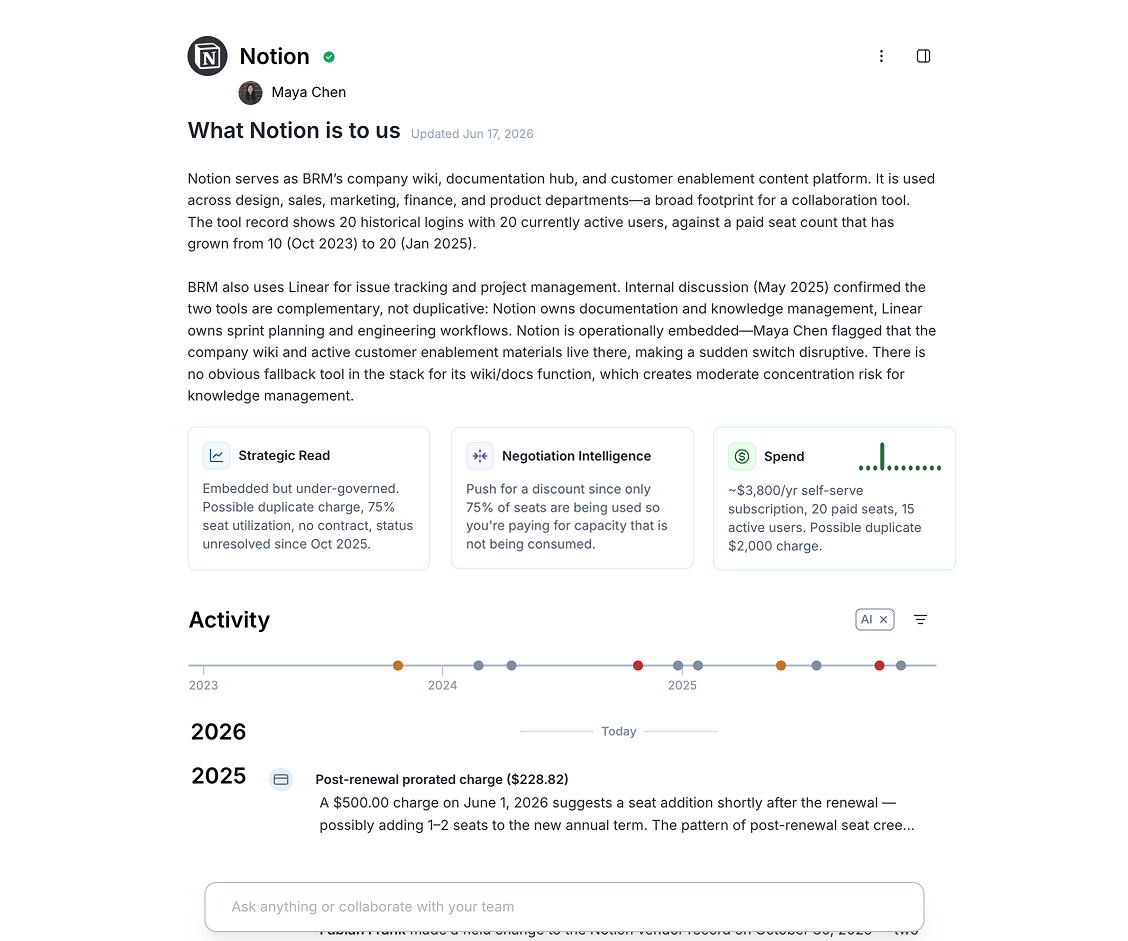
The Relationship View is a dedicated page in BRM for every vendor in your portfolio. Click a vendor and BRM immediately shows you everything it knows about that relationship — assembled, synthesized, and ready to act on.
Whether you need to make a decision on a vendor, answer a question, or bring insights to the business, you need to know your relationship with that vendor. You will need to know key details like:
* Who is this vendor to us?
* How are they used, and who uses them?
* How much do we pay?
* Who owns this vendor internally?
* Are we actually using the product?
* Are they delivering what was promised?
* Do we have any discounts? If so, what is the story behind them, and can we expect those to extend?
Not all of that knowledge lives in the contract. It’s in your various, sometimes siloed systems, in emails, or in your support tickets.
Now, it is in one place — the Relationship — the living, dynamic record that spans every agreement signed, every payment made, every email sent, and every conversation that shaped how things actually work.
Most tools collapse a relationship into two things: what was agreed to, and whether it was fulfilled. The Relationship View captures all four layers:
1. 📄 **Foundational:** Contracts, amendments, SOWs, order forms, renewal terms — the skeleton of the relationship.
2. 📊 **Performance**: Invoices, payment records, SLA data, and delivery confirmations — whether the relationship is healthy on paper.
3. 💬 **Communication:** Emails, escalations, negotiation context — the texture of the relationship that connects everything else.
4. 🧠 **Relationship Intelligence:** Key contacts, org changes, renewal risk signals, strategic importance — what the relationship tells you about the future.
## **Quick Start**
Getting to any Relationship View takes two clicks.
1. \*\*Log in to BRM: \*\* Head to your BRM workspace.
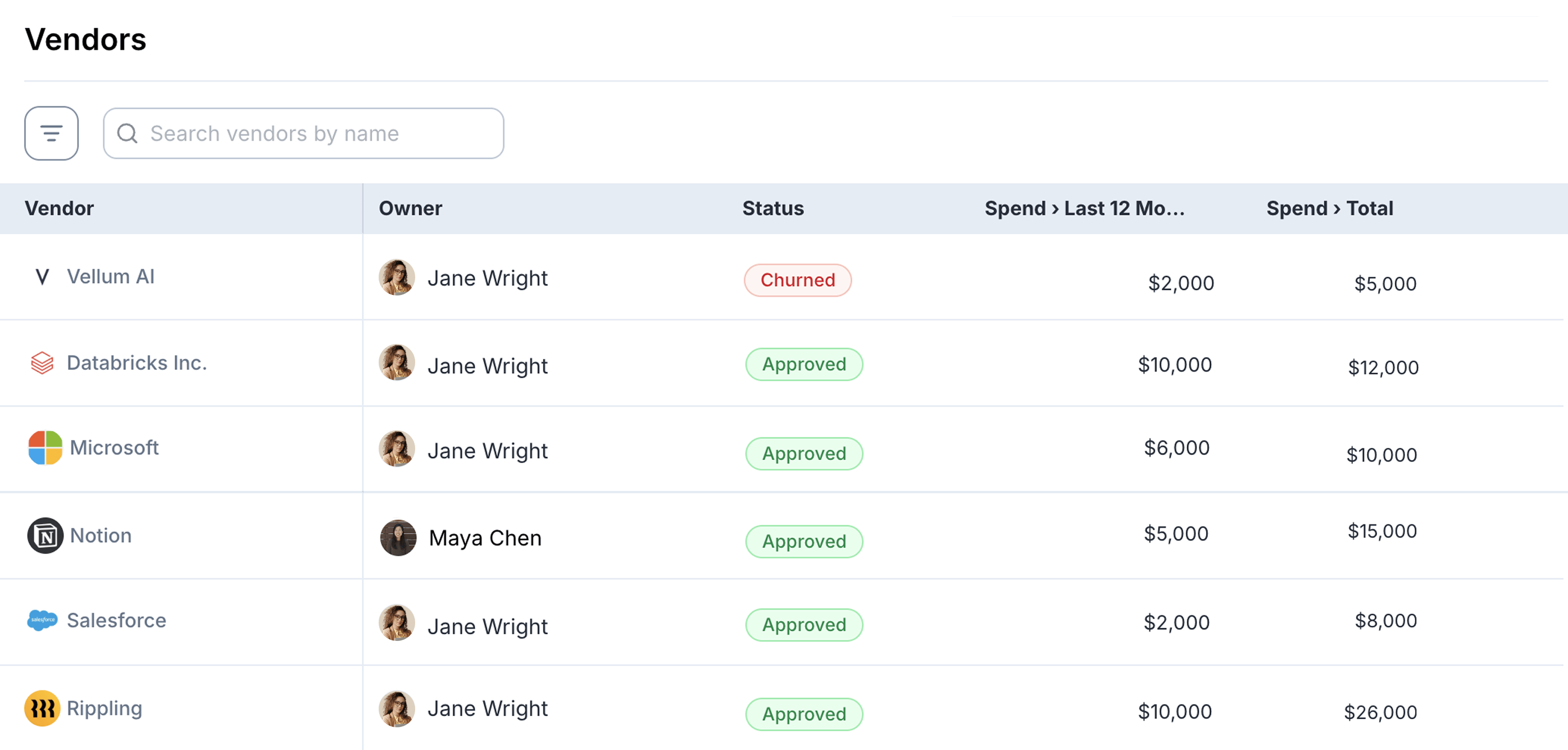
2. \*\*Go to Vendors: \*\* The Vendors list shows every vendor in your portfolio.
## **What Is the Relationship View?**
The Relationship View is a dedicated page in BRM for every vendor in your portfolio. Click a vendor and BRM immediately shows you everything it knows about that relationship — assembled, synthesized, and ready to act on.
Whether you need to make a decision on a vendor, answer a question, or bring insights to the business, you need to know your relationship with that vendor. You will need to know key details like:
* Who is this vendor to us?
* How are they used, and who uses them?
* How much do we pay?
* Who owns this vendor internally?
* Are we actually using the product?
* Are they delivering what was promised?
* Do we have any discounts? If so, what is the story behind them, and can we expect those to extend?
Not all of that knowledge lives in the contract. It’s in your various, sometimes siloed systems, in emails, or in your support tickets.
Now, it is in one place — the Relationship — the living, dynamic record that spans every agreement signed, every payment made, every email sent, and every conversation that shaped how things actually work.
Most tools collapse a relationship into two things: what was agreed to, and whether it was fulfilled. The Relationship View captures all four layers:
1. 📄 **Foundational:** Contracts, amendments, SOWs, order forms, renewal terms — the skeleton of the relationship.
2. 📊 **Performance**: Invoices, payment records, SLA data, and delivery confirmations — whether the relationship is healthy on paper.
3. 💬 **Communication:** Emails, escalations, negotiation context — the texture of the relationship that connects everything else.
4. 🧠 **Relationship Intelligence:** Key contacts, org changes, renewal risk signals, strategic importance — what the relationship tells you about the future.
## **Quick Start**
Getting to any Relationship View takes two clicks.
1. \*\*Log in to BRM: \*\* Head to your BRM workspace.
2. \*\*Go to Vendors: \*\* The Vendors list shows every vendor in your portfolio.
 3. \*\*Click any vendor: \*\* The Relationship View is the default page for every vendor in BRM.
4. \*\*View your Relationship: \*\* BRM has assembled everything it knows. You didn't have to ask.
💡 **TIP**
You can also reach any Relationship View by clicking a vendor name from an agreement, a transaction, or an Ask BRM response — anywhere a vendor is mentioned in BRM.
## **What You'll See**
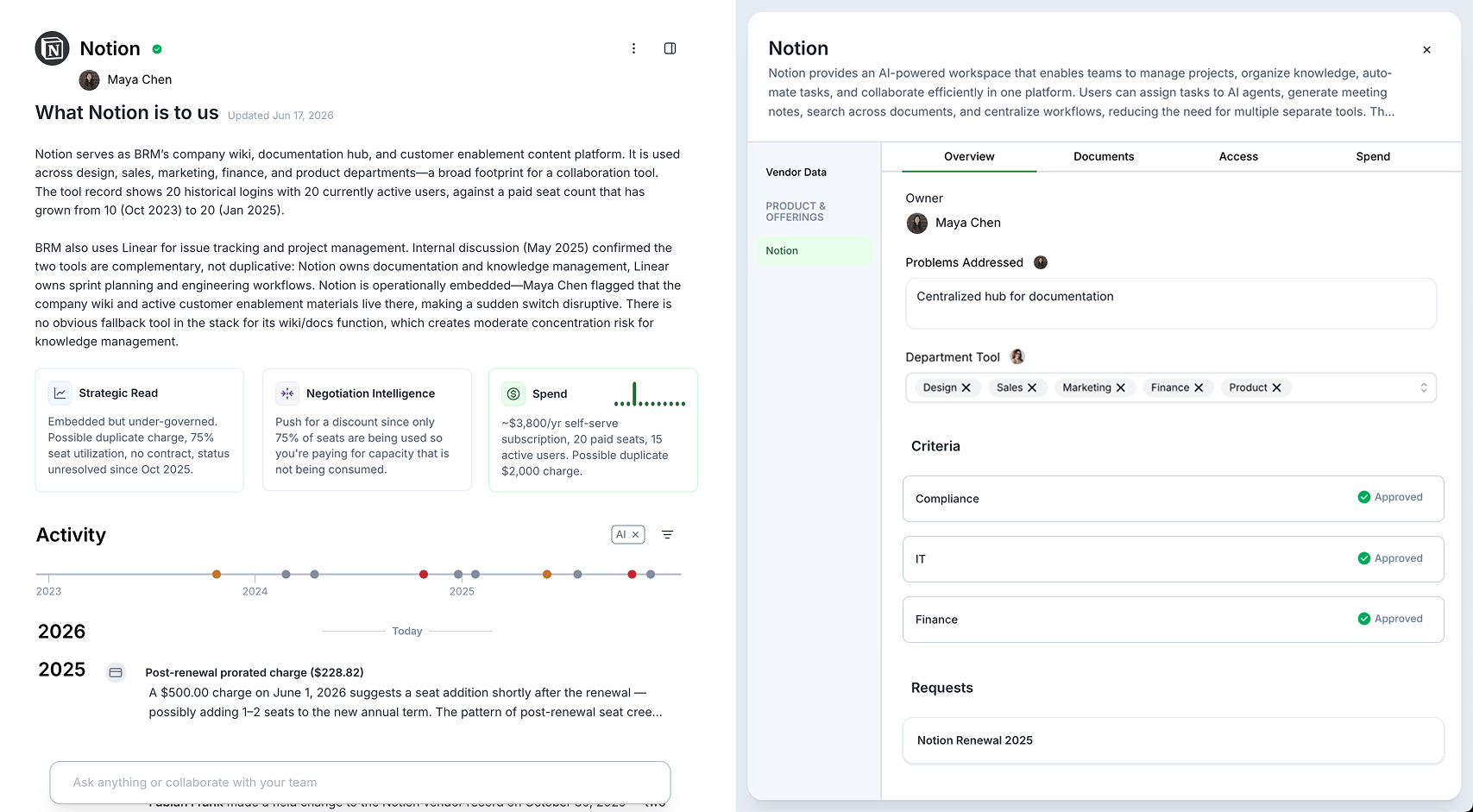
The Relationship View is organized into sections, each designed to answer a different set of questions about the vendor relationship. Together, they form a picture of the relationship that would have taken hours to assemble manually.
### Vendor Identity & Relationship Status
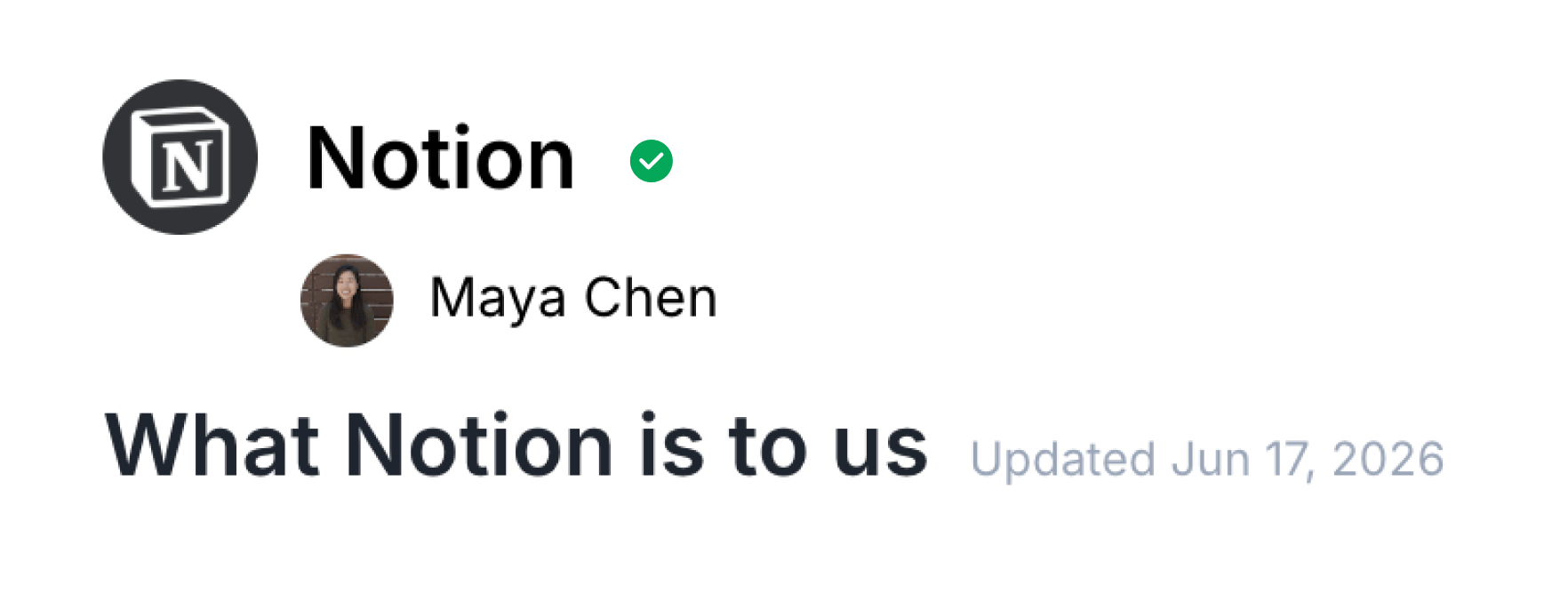
The vendor's name and logo, alongside your relationship status and the internal owner assigned to this vendor.
3. \*\*Click any vendor: \*\* The Relationship View is the default page for every vendor in BRM.
4. \*\*View your Relationship: \*\* BRM has assembled everything it knows. You didn't have to ask.
💡 **TIP**
You can also reach any Relationship View by clicking a vendor name from an agreement, a transaction, or an Ask BRM response — anywhere a vendor is mentioned in BRM.
## **What You'll See**
The Relationship View is organized into sections, each designed to answer a different set of questions about the vendor relationship. Together, they form a picture of the relationship that would have taken hours to assemble manually.
### Vendor Identity & Relationship Status
The vendor's name and logo, alongside your relationship status and the internal owner assigned to this vendor.
 ### Relationship Overview
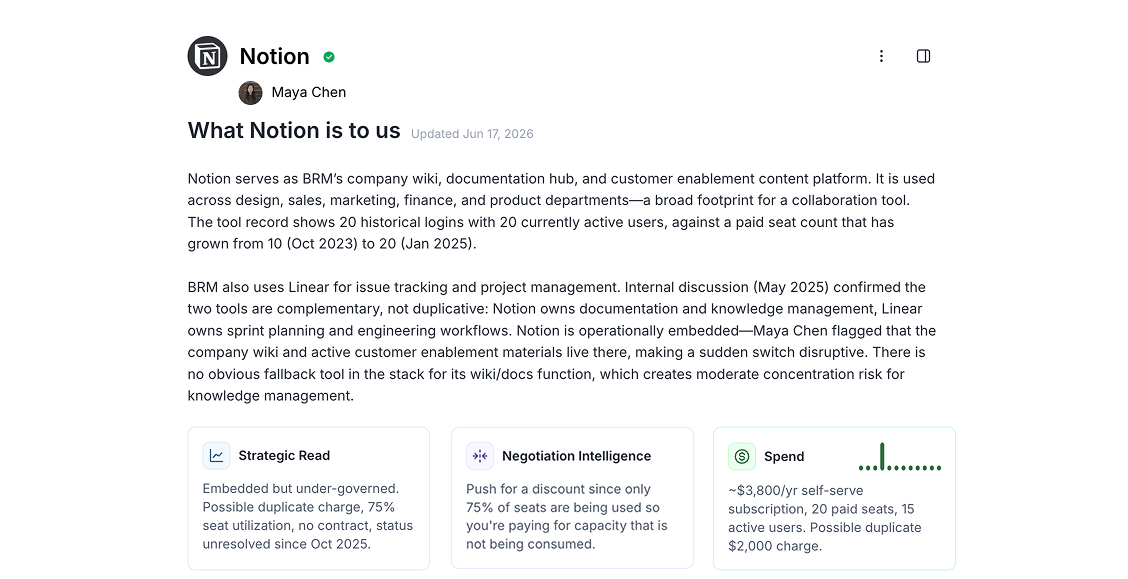
The heart of the Relationship View. An AI-generated briefing of the entire vendor relationship, structured so you can read it in two minutes and walk into any conversation prepared. It covers:
* **What this vendor is to you:** What they actually do for your business, how deeply they're embedded, and whether the relationship is strategic, transactional, or something in between.
* **Commercial terms:** Every active agreement, spend trajectory, billing structure, payment methods in use, and what's missing from your commercial record.
* **Key relationship contacts:** Named contacts on both sides, their roles, anyone who has departed, and where continuity risk lives.
* **Performance:** How the vendor has actually shown up, including support responsiveness, incident history, and whether they've followed through on commitments. Specific incidents, named and dated, are all included in this view.
* **Relationship texture:** Is there a strategic layer beyond the transactional? Exec connections, partnerships, warmth — assessed for whether it's genuine or simply relationship management.
* **Strategic read:** True relationship health, key risks, open threads, and what deserves attention before the next conversation.
* **Negotiation intelligence:** Specific opportunities for the next renewal, with the basis for each. What you don't yet know. Account continuity risks. And the strategic question: at your current scale, is this still the right vendor?
### Relationship Overview
The heart of the Relationship View. An AI-generated briefing of the entire vendor relationship, structured so you can read it in two minutes and walk into any conversation prepared. It covers:
* **What this vendor is to you:** What they actually do for your business, how deeply they're embedded, and whether the relationship is strategic, transactional, or something in between.
* **Commercial terms:** Every active agreement, spend trajectory, billing structure, payment methods in use, and what's missing from your commercial record.
* **Key relationship contacts:** Named contacts on both sides, their roles, anyone who has departed, and where continuity risk lives.
* **Performance:** How the vendor has actually shown up, including support responsiveness, incident history, and whether they've followed through on commitments. Specific incidents, named and dated, are all included in this view.
* **Relationship texture:** Is there a strategic layer beyond the transactional? Exec connections, partnerships, warmth — assessed for whether it's genuine or simply relationship management.
* **Strategic read:** True relationship health, key risks, open threads, and what deserves attention before the next conversation.
* **Negotiation intelligence:** Specific opportunities for the next renewal, with the basis for each. What you don't yet know. Account continuity risks. And the strategic question: at your current scale, is this still the right vendor?
 ### Activity Timeline
A complete chronological record of the relationship — from the very first interaction to today. Two types of events appear on the timeline:
* **Milestone events:** AI-synthesized moments that shaped the relationship: contracts signed, significant payments, ownership changes, renewal decisions. Each one is contextualized — not just "contract signed" but what that event means for where the relationship stands today.
* **Email events:** Individual emails between your team and the vendor, surfaced from email ingestion and placed in chronological context. The failed payment email. The renewal negotiation that happened six months before the formal contract date. All of it, visible.
### Activity Timeline
A complete chronological record of the relationship — from the very first interaction to today. Two types of events appear on the timeline:
* **Milestone events:** AI-synthesized moments that shaped the relationship: contracts signed, significant payments, ownership changes, renewal decisions. Each one is contextualized — not just "contract signed" but what that event means for where the relationship stands today.
* **Email events:** Individual emails between your team and the vendor, surfaced from email ingestion and placed in chronological context. The failed payment email. The renewal negotiation that happened six months before the formal contract date. All of it, visible.
 ### Ask BRM
A persistent AI search bar, grounded in the full context of this specific relationship. Ask anything:
* "What's the auto-renewal clause and notice window?"
* "How much have we spent year-to-date vs. what we contracted?"
* "Have there been any unresolved payment failures?"
* "What did we agree to on implementation fees before the deal closed?"
* "Who owns this relationship and when did they take it over?"
Answers are grounded in BRM's data for this relationship — contracts, emails, payments, and contacts. If the answer isn't in the data, BRM will tell you that too.
You will find Ask BRM anchored to the bottom of your Relationship page.
### Details panel
A slide-out drawer, accessible by clicking the icon button in the upper right-hand corner, with the supporting detail behind the overview, organized into three to four areas:
* **Overview**: Includes additional high-level details of the Relationship, such as owners, criteria (role-based data on the vendor, only viewable with the appropriate permissions), and requests (a compilation of all new, archived, and current requests related to the vendor).
* **Documents:** Displays source files: MSAs, order forms, amendments, SOWs, and any supporting documents linked to this vendor.
* **Access (software-only)**: Shows vendor usage details across individuals and teams, such as when users last logged in, and the percentage of active users.
* **Products & Offerings:** Every product and offering associated with this vendor is mapped from their agreements, so you can see everything you have paid for for each vendor.
* **Spend**: Shows all historical spend across your vendor, broken down by products.
### Ask BRM
A persistent AI search bar, grounded in the full context of this specific relationship. Ask anything:
* "What's the auto-renewal clause and notice window?"
* "How much have we spent year-to-date vs. what we contracted?"
* "Have there been any unresolved payment failures?"
* "What did we agree to on implementation fees before the deal closed?"
* "Who owns this relationship and when did they take it over?"
Answers are grounded in BRM's data for this relationship — contracts, emails, payments, and contacts. If the answer isn't in the data, BRM will tell you that too.
You will find Ask BRM anchored to the bottom of your Relationship page.
### Details panel
A slide-out drawer, accessible by clicking the icon button in the upper right-hand corner, with the supporting detail behind the overview, organized into three to four areas:
* **Overview**: Includes additional high-level details of the Relationship, such as owners, criteria (role-based data on the vendor, only viewable with the appropriate permissions), and requests (a compilation of all new, archived, and current requests related to the vendor).
* **Documents:** Displays source files: MSAs, order forms, amendments, SOWs, and any supporting documents linked to this vendor.
* **Access (software-only)**: Shows vendor usage details across individuals and teams, such as when users last logged in, and the percentage of active users.
* **Products & Offerings:** Every product and offering associated with this vendor is mapped from their agreements, so you can see everything you have paid for for each vendor.
* **Spend**: Shows all historical spend across your vendor, broken down by products.
 ## **Why This Changes How You Work**
### **Before a renewal call**
Open the Relationship View. Read the overview. It tells you what's in your agreements, what was committed before the last contract closed, what risks deserve attention, and where the strongest opportunities are in the conversation ahead. You've never been this prepared walking in.
### **When someone asks, "What do we pay these guys?"**
Open the Relationship View. The answer is there — and so is the spend trajectory, the payment breakdown, the gap between what you contracted and what you've actually spent, and a flag for any anomalies. You don't need to dig through PDFs or say "I'll follow up."
### **When a team member who managed a vendor relationship leaves**
Everything they knew is in BRM. The emails, the negotiations, the contacts, the context that shaped how the relationship actually works. Relationship ownership changes four times in eight months? The institutional memory doesn't go with any one person.
### **When you need to understand a new vendor fast**
The Relationship View starts at the beginning and brings you current. What the vendor is, what you've paid, who you've talked to, what's been flagged, and what you should be thinking about before the next conversation — in one page, already assembled.
The person who has the answer walks into every meeting prepared. The Relationship View makes that person everyone on your team — before the meeting starts.
## **Questions?**
Reach out to BRM support.
## **Why This Changes How You Work**
### **Before a renewal call**
Open the Relationship View. Read the overview. It tells you what's in your agreements, what was committed before the last contract closed, what risks deserve attention, and where the strongest opportunities are in the conversation ahead. You've never been this prepared walking in.
### **When someone asks, "What do we pay these guys?"**
Open the Relationship View. The answer is there — and so is the spend trajectory, the payment breakdown, the gap between what you contracted and what you've actually spent, and a flag for any anomalies. You don't need to dig through PDFs or say "I'll follow up."
### **When a team member who managed a vendor relationship leaves**
Everything they knew is in BRM. The emails, the negotiations, the contacts, the context that shaped how the relationship actually works. Relationship ownership changes four times in eight months? The institutional memory doesn't go with any one person.
### **When you need to understand a new vendor fast**
The Relationship View starts at the beginning and brings you current. What the vendor is, what you've paid, who you've talked to, what's been flagged, and what you should be thinking about before the next conversation — in one page, already assembled.
The person who has the answer walks into every meeting prepared. The Relationship View makes that person everyone on your team — before the meeting starts.
## **Questions?**
Reach out to BRM support.