

Quick Start: How to Access the Agreements Overview
Getting there is simple:- Log in to BRM
- Go to Agreements in the main navigation
- Click any agreement to open the Agreements Overview
- AI Chat: Click any agreement link in an Ask BRM response
- Pre-verification access (if enabled for your organization)
What You’ll See: The 6 Key Features
1. Dynamic Header: Facts First, Tailored to Agreement Type
BRM detects what kind of agreement you’re looking at—SaaS, services, lease, hardware—and immediately surfaces the high-value facts: annualized cost, total cost, commercial model, term, and next action. No blank fields. No irrelevant sections. Just what matters for this agreement. The person who asks “How much do we pay?” gets their answer in 10 seconds instead of 20 minutes.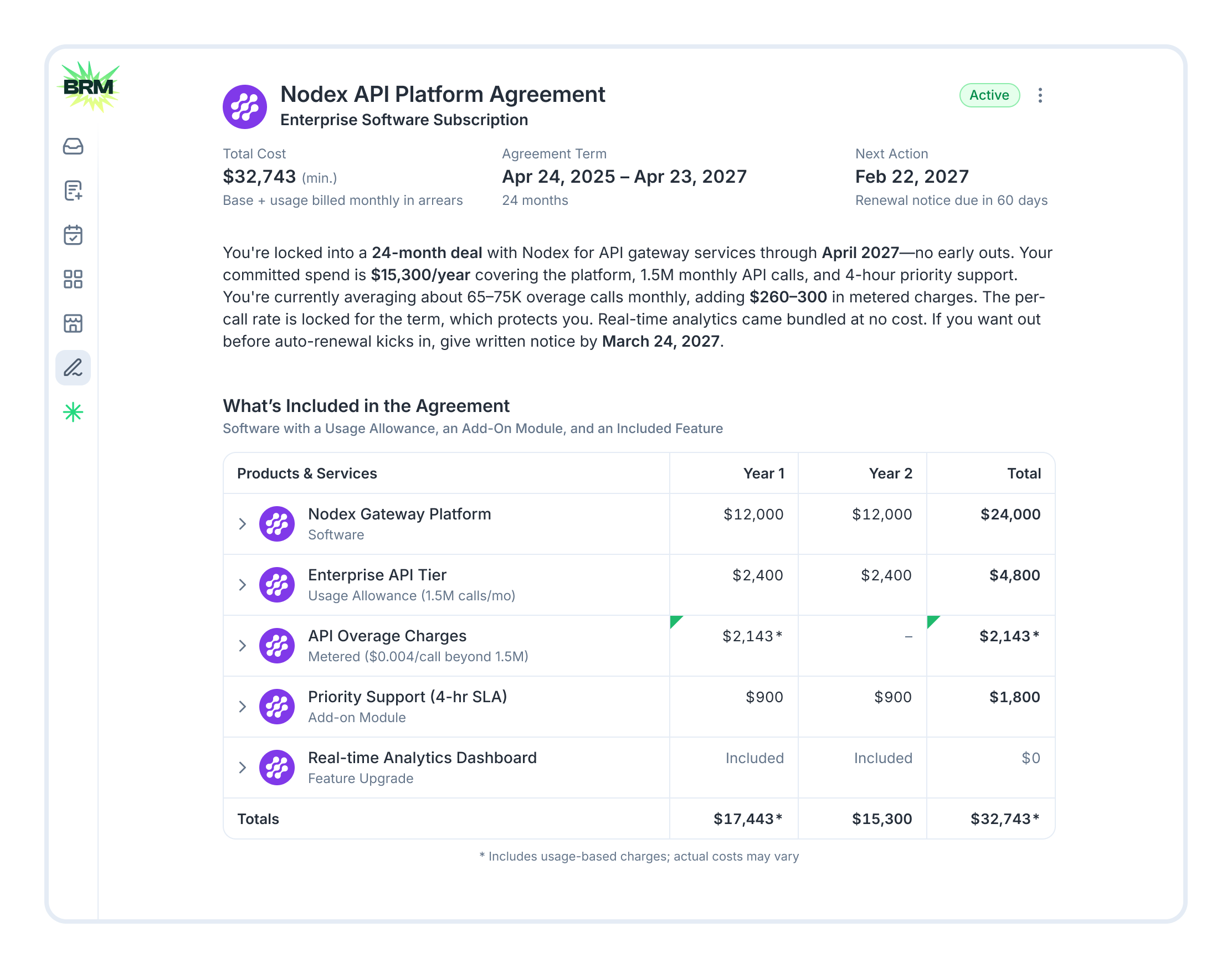
2. Line-Item Extraction: See What You Actually Bought
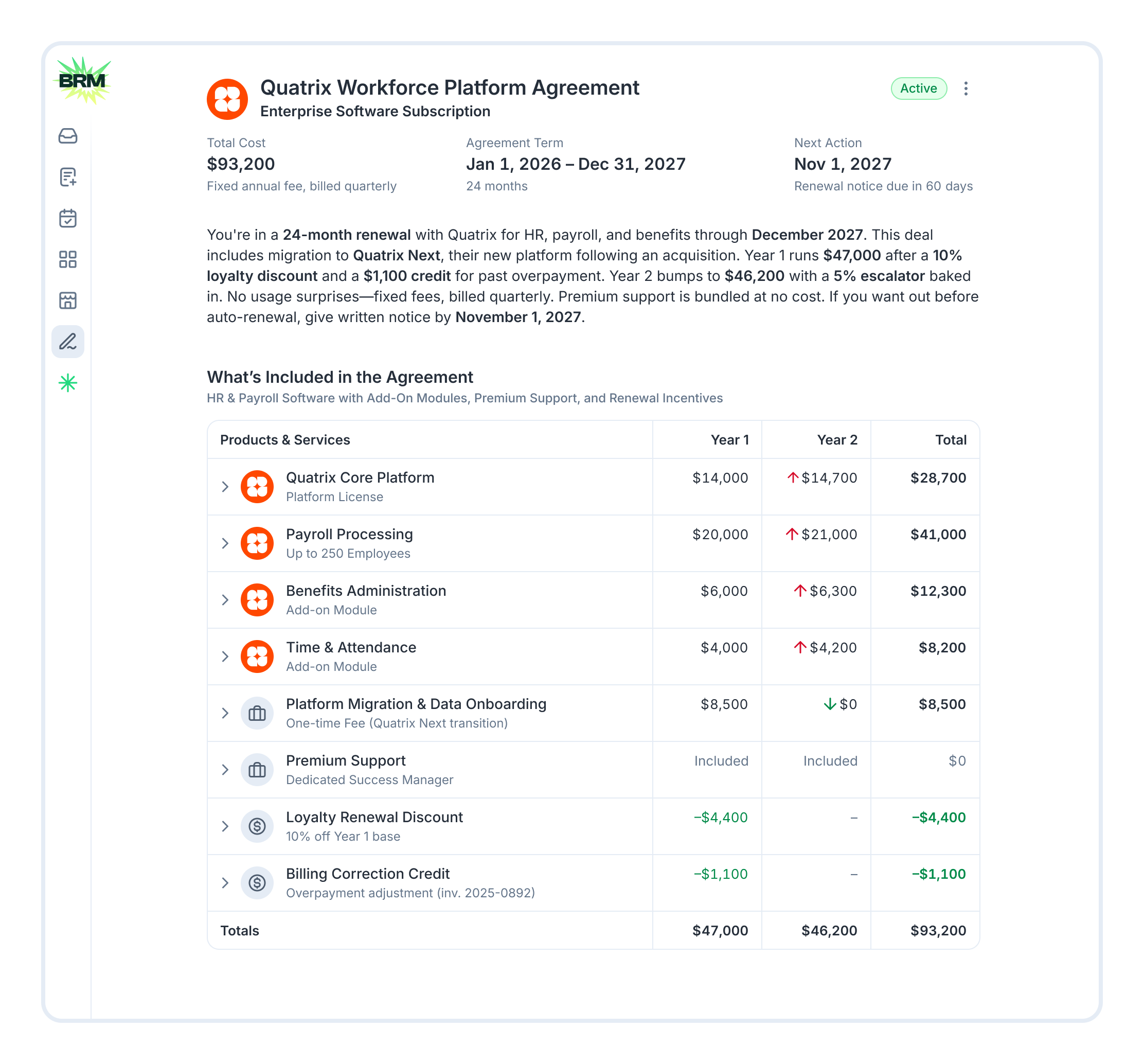
Modules, SKUs, add-ons, implementation fees—all pulled out and organized into a comparable table, and mapped to a real product or service. See exactly what you bought and what you’re paying for each piece. This is what makes line-item negotiation possible. Real examples from customers:- Three overlapping project management tools nobody had noticed
- “Platform fees” they’d forgotten they were paying
- Implementation fees that were supposed to be one-time but were recurring monthly
3. Multi-Tool Visibility: Know the Products, Not Just the Vendors
That “HubSpot” agreement? It might include Sales Hub, Marketing Hub, and CRM—three different products with three different use cases and three different costs. One contract. Six distinct products. Zero visibility—until now. BRM identifies the actual tools inside each agreement, revealing overlaps and long-tail spend hiding in plain sight. Stop managing vendors. Start managing your stack.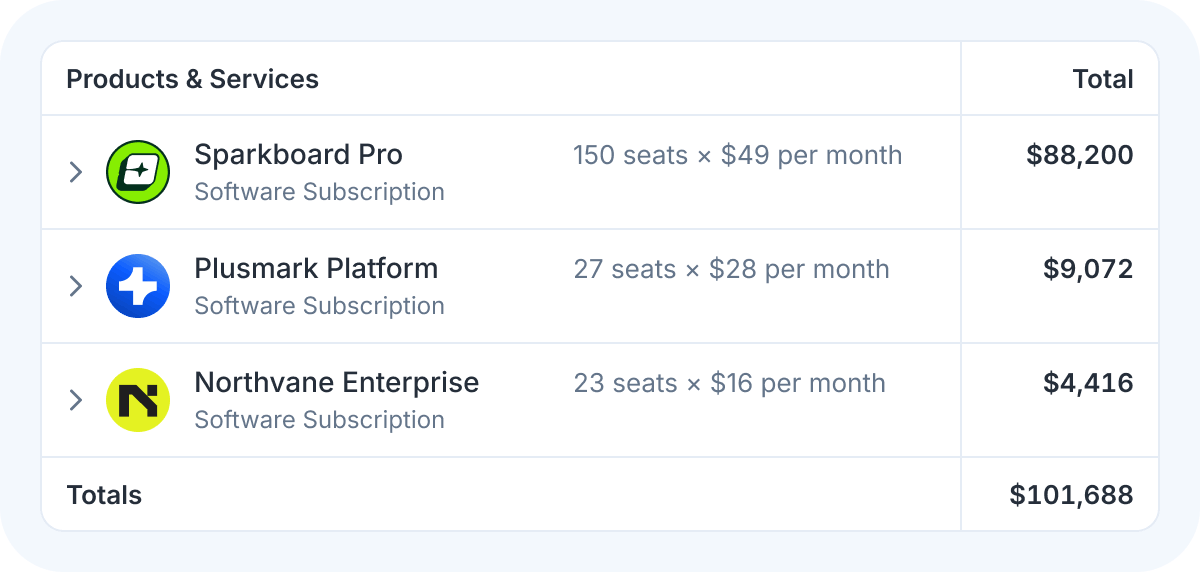
4. Finance-First Classification
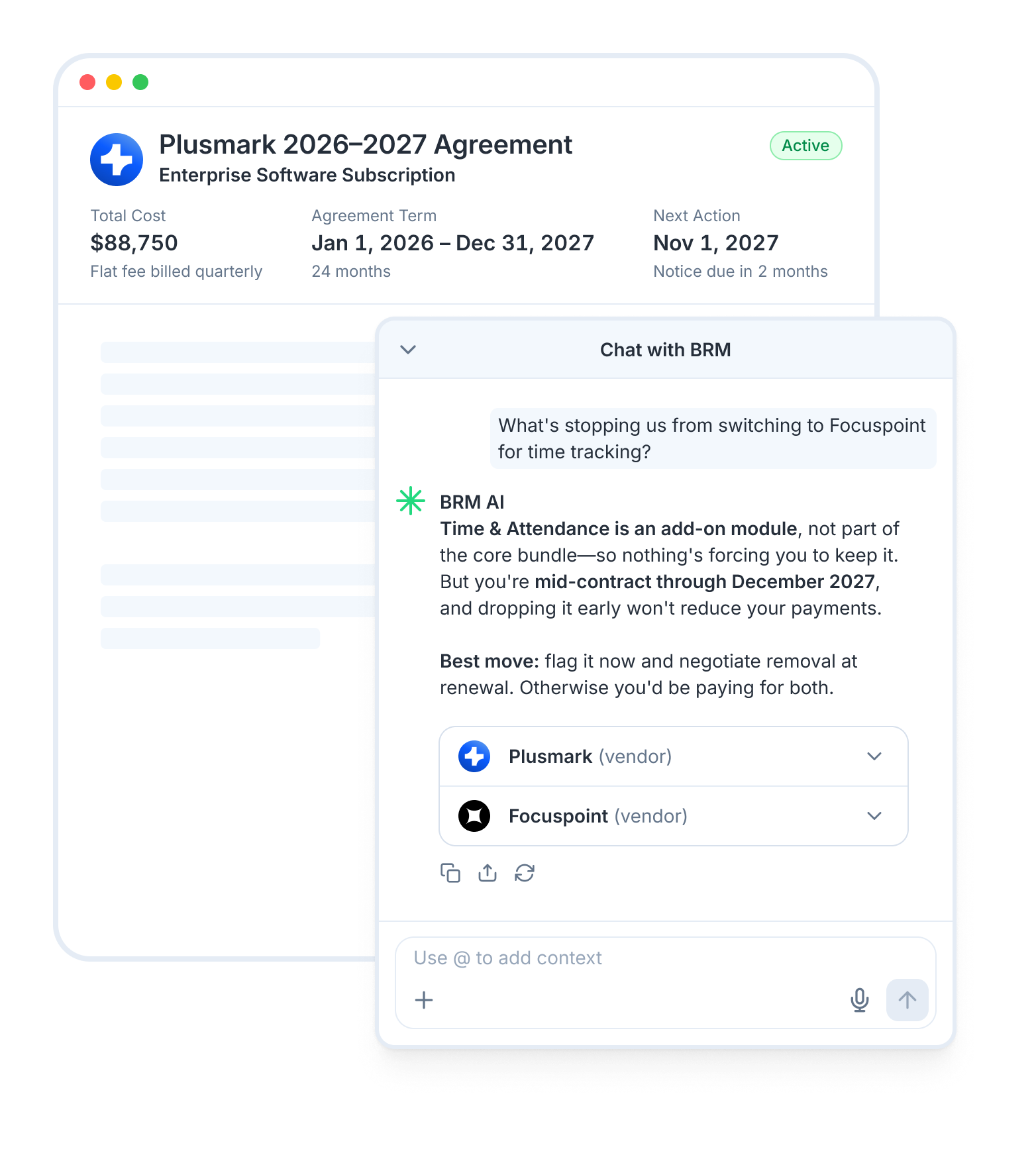
Every agreement gets typed with a taxonomy built for portfolio analysis: subscription, usage/metered, one-time, services, hardware/lease. Now your comparisons are apples-to-apples across vendors and categories. Know what you’re spending on SaaS vs. services vs. hardware at a glance.5. Ask BRM: AI That Actually Knows Your Contracts
Ask plain-English questions directly on the agreement page:- “How much would we pay for 15 more seats?”
- “Do we have other tools that do this?”
- “What happens if we cancel early?”
- “Can we terminate before the end date?”
6. Full Auditability
Access all source documents, see cost breakdowns including annualized totals, and view verification history. When someone asks, “Where did this number come from?”—you have the answer. Every field links back to the source. Every calculation is transparent.Why This Changes How You Work
The old way: Someone asks, “How much do we pay Salesforce?” and you spend 20 minutes hunting through a PDF, checking amendments, doing math, and still not being 100% confident in your answer. The new way: Open the agreement. The answer is right there—annualized, verified, current. The Agreements Overview moves your team from reactive verification to proactive decisioning:- Negotiate at the line-item level, not just the total
- Catch renewals before they auto-trigger
- See your full stack clearly, even when one vendor sells you five products
- Make faster, more confident portfolio decisions
- Walk into meetings with answers, not follow-up promises
- Get 10+ hours per month back—time returned to strategic work instead of PDF archaeology
Why This Exists Now (And Didn’t Before)
Your contracts shouldn’t be dead data
Your contracts contain some of the most important data about your business—what you’re committed to, what you’re paying, and when you need to act. But as PDFs are scattered across email and drives, that data is effectively dead. You can’t query it. You can’t act on it. You can’t even find it when you need it most. Most contract tools digitize PDFs and hope humans can make sense of them. The problem was never storage. It was structure. Contracts are written in natural language—bespoke terms, nested amendments, vendor-specific quirks. Making them queryable and comparable at scale required something that didn’t exist until recently: AI that can reason over unstructured text, grounded in a structured understanding of what it’s reading.What we built
We’ve been building what informed decision-makers need - not just a contract viewer, but a unified data model—an ontology that understands what a vendor is, what an agreement is, what a line-item is, and how they all relate. This foundation is what lets us:- Extract line-items automatically
- Detect agreement types
- Map multiple tools to a single vendor
- Give you answers grounded in actual contract language
- Keep everything current as amendments roll in